What Screens Are Teaching the Adolescent Brain
Youth Development

Published on: May 28, 2026
A generation of young people are learning about relationships and the world around them through a screen. Technology has created incredible opportunities for agency and learning. And it shapes how adolescents make sense of the world around them.
For youth workers, this creates an important question. What happens to adolescent development when so much of life is filtered through a screen instead of human connection?
As youth workers, we often see the effects before we fully understand the science behind them. Young people may struggle to read emotions, sit with discomfort, navigate conflict, or engage deeply in face-to-face conversations.
These are not simply behavior problems or signs of disinterest. In many ways, they reflect how the adolescent brain is adapting to the environment it spends the most time in.
The adolescent brain is built for relationships
Adolescence is an important period of brain development. During these years, young people are learning how to understand emotions, relationships, social cues, and identity.
Much of this development happens through real-world human interaction.
Healthy adolescent development is strengthened when young people experience:
- Face-to-face conversations
- Emotional connection and belonging
- Unstructured social interaction
- Opportunities to navigate discomfort and conflict
- Meaningful relationships with trusted adults
These experiences help strengthen the brain’s ability to process complex social and emotional information.
Screens may shape how the brain experiences the world
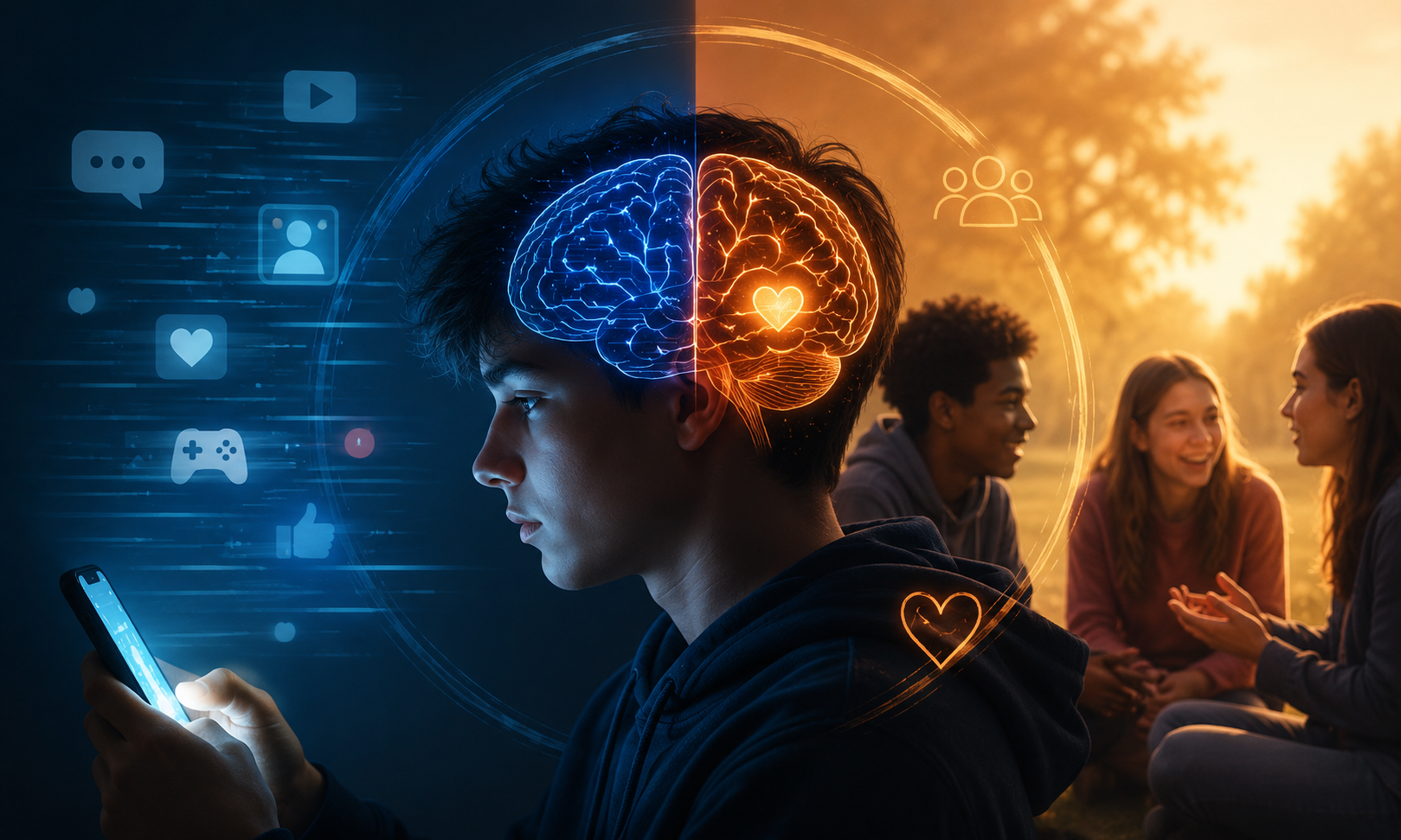
Emerging neuroscience is helping us better understand how human beings process the world around them. Researchers studying hemispheric lateralization, including the work of Iain McGilchrist, suggest that the two hemispheres of the brain tend to engage with reality in different ways.
While both hemispheres work together:
- The LEFT HEMISPHERE specializes in COMPLICATED issues often associated with detail, categorization, speed, and control.
- The RIGHT HEMISPHERE specializes in COMPLEX issues connected to relationships, emotional nuance, context, and human understanding.
Many screen-based experiences naturally pull adolescents toward the kinds of processing more associated with left-hemisphere attention:
- Fast information and short attention bursts
- Categorizing people through profiles and labels
- Constant novelty and stimulation
- Reduced need to interpret body language or emotional nuance
- Limited opportunities for deep relational engagement
While screen-based experiences are not inherently harmful, the concern is whether adolescents are spending enough time in experiences that more heavily engage the right hemisphere of their brain.
Young people still need face-to-face interactions, belonging, and meaningful connection. These experiences help develop the parts of the brain that allow people to navigate relationships, regulate emotions, and understand the world beyond quick reactions and surface-level interactions.
Youth workers play an incredibly important role in helping restore that balance between the two sides of their brain. Every meaningful interaction you create helps young people strengthen the right hemisphere of their brain in ways that screens do not.
You may be more important than ever
Young people need human beings who can help them experience trust, belonging, reflection, and understanding in a world increasingly dominated by digital interaction.
That is why the work of youth workers matters so deeply right now. Your presence helps young people slow down, connect, process emotions, and strengthen the right hemisphere of the brain through meaningful human relationships.
These experiences shape healthy development and remind us why continued learning and growth through quality training for youth workers is so important in today’s world.
If you want to deepen your understanding of adolescent development, brain science, and the growing impact screens may have on young people, explore YIPA’s course, Teens, Screens, Science, and Adolescent Development.
When you understand how adolescents experience and process the world, you start seeing them as human beings becoming themselves. The more we understand the developing brain, the better we become at creating the relationships that support positive youth development.
Related Learning Opportunities

People-Centered Leadership Certificate Course for Youth
4.4


Free to YIPA Members
-
 Completion Certificate
-
100% Online Course


The Art & Science of Youth Work certificate Course
4.9
Free to YIPA Members
-
Completion Certificate
-
100% Online Course

Identity Development and Resilience in Adolescence
Free to YIPA Members
-
Completion Certificate
-
100% Online Course
-
 Youth Development

The Trials and Tribulations of Adolescence
5.0
Free to YIPA Members
-
Completion Certificate
-
100% Online Course
-
Youth Development
Enhancing Executive Functioning Skills
5.0
Free to YIPA Members
-
Completion Certificate
-
100% Online Course
-
Youth Development
Family Dynamics Shaped by Domestic Violence
Free to YIPA Members
-
Completion Certificate
-
100% Online Course
-
Youth Development
Embracing Positive Youth Development
Free to YIPA Members
-
Completion Certificate
-
100% Online Course
-
Youth Development